 13 Mar 2026
 By Vista Corp
Over the past few weeks, global headlines have been dominated by escalating tensions in the Middle East — missile strikes, geopolitical standoffs, and growing uncertainty across international markets. Whenever events like these unfold, investors and businesses tend to ask the same question: where can stability still be found?
History shows that periods of global uncertainty often force companies to rethink where they operate, invest, and expand. And yet, despite the turbulence in the region and the volatility affecting many global economies, the United Arab Emirates continues to attract businesses, investors, and entrepreneurs from around the world.
This raises an interesting question.
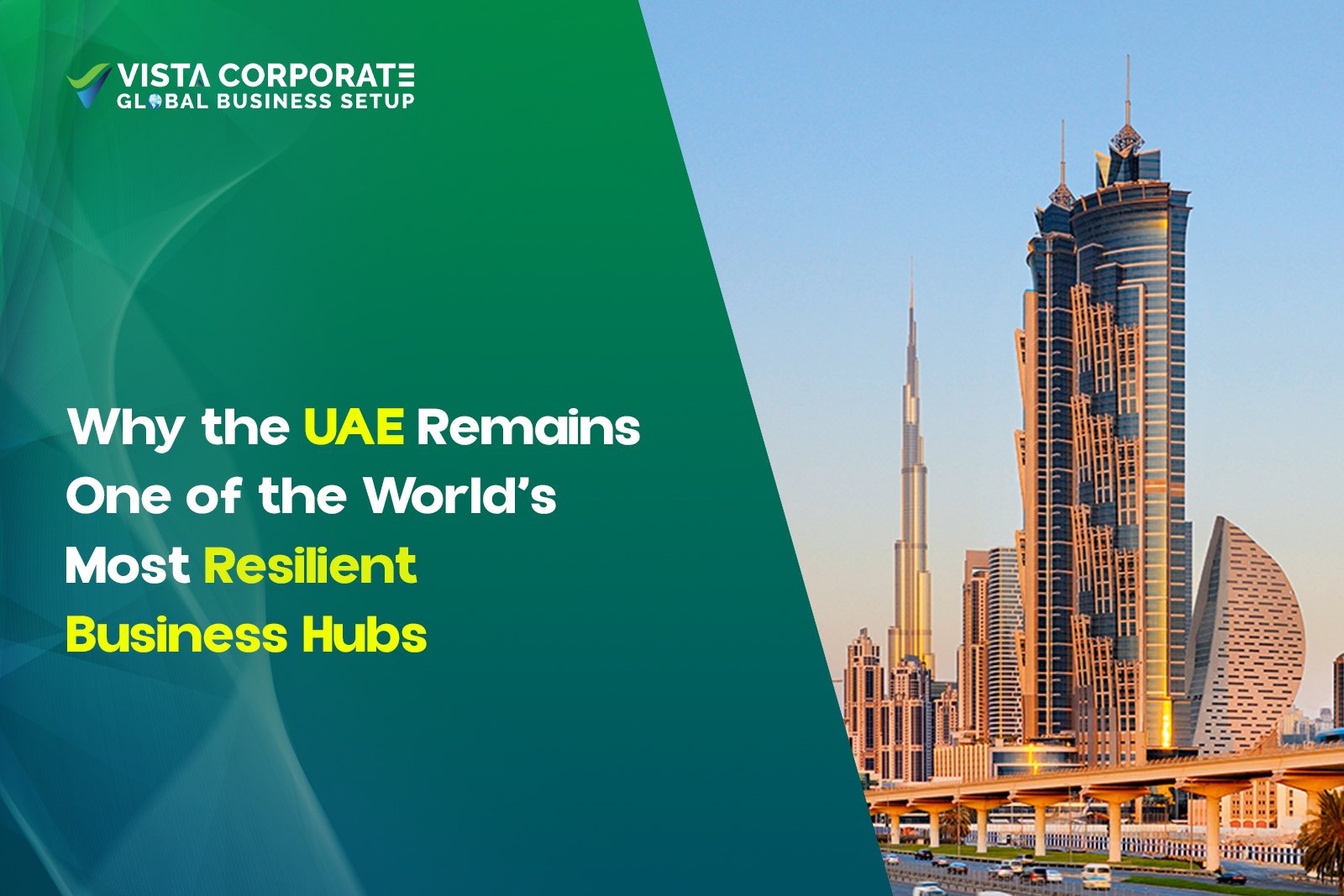
Why does the UAE repeatedly emerge as a stable and reliable business destination, even during periods of global disruption?
The answer lies in a pattern the country has demonstrated over the past two decades — one where economic shocks, financial crises, and global disruptions have not weakened the UAE’s position, but instead strengthened its reputation as one of the world’s most resilient business hubs.
What Makes a Business Hub Truly Resilient?
When people describe a country as a resilient business hub, what does that actually mean?
Is it simply about economic growth numbers? Or is there something deeper behind the term?
Think about it this way.
Every economy performs well when global markets are stable. Investment flows in. Trade expands. Businesses grow. That part is relatively easy.
The real test comes when things go wrong.
Market crashes. Natural calamities. Global pandemics.
Political tensions that disrupt trade routes and supply chains.
These are the moments when businesses begin asking difficult questions. Where should we operate? Which markets are stable enough to build long-term plans around?
A resilient business hub is one that can absorb these shocks without losing investor confidence. It adapts quickly, introduces policy reforms when needed, and keeps its economic engine running even when global conditions become unpredictable.
For entrepreneurs and international companies, that kind of resilience matters more than short-term growth. Imagine launching a regional headquarters, building supply chains, or committing to long-term investments in a country. You would naturally want an environment where policies are predictable, infrastructure remains reliable, and the business ecosystem continues to function even during turbulent times.
This is exactly where the UAE’s economic model becomes interesting.
Over the past two decades, the country has faced several global disruptions — from financial crises to oil market volatility and even a worldwide pandemic. Yet each time, instead of weakening its position as a business destination, the UAE adapted and emerged stronger.
To understand why, it helps to look at how the country responded during the global economy’s most serious tests.
- The 2008 Global Financial Crisis
To understand the UAE’s resilience, we need to go back to 2008, when the global financial system experienced one of its most severe shocks.
Banks collapsed across the United States and Europe. Credit markets froze. Global investment slowed dramatically. Within months, economies around the world were facing recession.
Dubai, which had experienced rapid growth during the early 2000s, also felt the impact.
Property prices declined, liquidity tightened, and several government-linked entities faced pressure to restructure their obligations. One of the most widely discussed developments at the time was the debt restructuring of Dubai World in 2009, which involved restructuring roughly $25 billion of debt.
But what happened next is what truly illustrates resilience.
The UAE federal government and the Central Bank stepped in to stabilise the financial system, introducing support measures that included $20 billion in emergency funding for Dubai’s banking sector. At the same time, regulators strengthened oversight across financial institutions and introduced reforms aimed at improving transparency and risk management.
These steps helped restore confidence in the banking sector and reassured international investors that the UAE was willing to act decisively to maintain financial stability.
In other words, the crisis forced difficult adjustments — but it also led to stronger financial regulation, better capital buffers, and a more resilient banking system that would later prove critical during future global disruptions.
- The Oil Price Collapse (2014–2016)
Just a few years later, the global economy faced another shock — this time from energy markets.
Between 2014 and 2016, global oil prices dropped sharply, falling from over $100 per barrel to below $40. For many oil-dependent economies, the consequences were immediate.
Government revenues declined, public spending came under pressure, and economic growth slowed significantly across several energy-exporting countries.
But the UAE’s economic structure had already begun to evolve.
By that point, sectors such as trade, tourism, aviation, logistics, financial services, and real estate had become major drivers of economic activity — especially in Dubai. In fact, oil contributes only a small share of Dubai’s GDP, with the emirate relying heavily on non-oil industries.
During the oil price downturn, these sectors continued to expand.
Dubai’s position as a global trade and logistics hub, supported by infrastructure such as Jebel Ali Port and Dubai International Airport, allowed economic activity to continue flowing even as energy markets weakened.
The UAE government also accelerated its diversification strategy, investing further in infrastructure, tourism development, and global trade connectivity.
The result?
While the oil shock affected the broader region, the UAE demonstrated that its economy was no longer solely dependent on hydrocarbons. The growth of non-oil sectors helped sustain economic momentum, reinforcing the country’s long-term strategy of building a diversified and globally connected economy.
- The COVID-19 Pandemic
If the financial crisis tested the UAE’s financial system, the COVID-19 pandemic tested the entire global economy.
By early 2020, borders were closing, flights were grounded, and entire industries were suddenly forced to stop. Tourism, aviation, hospitality, and retail — sectors that normally drive economic growth — experienced an unprecedented slowdown across the world.
For a city like Dubai, which is one of the world’s most connected travel and business hubs, the challenge was particularly significant.
Global tourism collapsed, and according to the United Nations World Tourism Organisation, international tourist arrivals worldwide fell by around 74% in 2020.
Yet the UAE’s response was notably swift.
The government introduced a series of economic stimulus measures and financial support programs aimed at helping businesses maintain operations during the disruption. At the same time, the country launched one of the world’s fastest vaccination campaigns, allowing economic activity to resume sooner than in many other parts of the world.
But the real turning point came in 2021 with Expo 2020 Dubai.
Originally postponed due to the pandemic, the event eventually drew over 24 million visitors from around the world, becoming one of the first large-scale global gatherings after the pandemic. It helped revive tourism, hospitality, and business activity across the country.
The recovery that followed was equally telling. Dubai’s tourism sector rebounded strongly, welcoming more than 17 million international visitors in 2023, surpassing pre-pandemic levels and reinforcing the emirate’s role as one of the world’s leading travel destinations.
What does this tell us?
It shows that resilience is not just about surviving a crisis. It’s about how quickly an economy adapts, restores confidence, and returns to growth.
And once again, the UAE demonstrated that when global disruptions occur, its ability to respond quickly and decisively becomes one of its greatest strengths.
- Rainfalls and Floods (2024)
Just when it seemed the UAE had navigated financial crises, oil shocks, and a global pandemic, another challenge arrived — this time from nature.
In April 2024, the UAE experienced one of the most intense rainfall events in its recorded history. In a country where annual rainfall is usually limited, the storm brought an extraordinary downpour. At Dubai International Airport, weather stations recorded over 250 millimetres of rain within roughly 24 hours, an amount that far exceeds the UAE’s average annual rainfall.
Naturally, the impact was visible.
Roads flooded, flights were temporarily disrupted, and parts of the city experienced short-term infrastructure strain. For a moment, global media outlets were asking an important question: how would one of the world’s busiest international cities handle such an unexpected event?
The response was swift.
Authorities mobilised emergency teams across the country, intensified drainage operations, and began infrastructure repairs almost immediately. Within days, major transport networks and airports resumed normal operations, and businesses across Dubai and other emirates returned to routine activity.
What does this incident tell us about economic resilience?
It shows that resilience is not limited to financial systems or economic policies. It also includes infrastructure preparedness, institutional coordination, and a city’s ability to recover quickly from unexpected disruptions.
And once again, the UAE demonstrated that its resilience extends beyond economics — it is embedded in the way the country manages challenges and keeps its business environment functioning even under unusual circumstances.
- Global Economic Uncertainty (2022 Onwards)
Over the past few years, the global economy has entered yet another period of uncertainty. Only this time, the challenges have been more complex and interconnected.
Inflation surged across many major economies, pushing up the cost of goods, energy, and transportation. Supply chains, already strained during the pandemic, continued to experience disruptions. At the same time, geopolitical tensions in various parts of the world — including developments closer to the Middle East — created a climate where global investors began reassessing risk.
When markets become unpredictable, investor confidence is often the first thing to wobble.
So what happens in a moment like this? Businesses begin asking practical questions. Where can we operate with stability? Which markets continue to offer predictability even when global conditions become volatile?
Once again, the UAE found itself in a unique position.
While many economies struggled with rising deficits and inflationary pressures, the UAE maintained a relatively disciplined fiscal approach. Government finances remained stable, regulatory policies continued to support business activity, and authorities focused on maintaining an environment where companies could operate with clarity and confidence.
Equally important was the country’s diplomatic posture.
The UAE has consistently positioned itself as a bridge between regions — maintaining constructive relationships with global partners across different geopolitical landscapes. During periods of regional tension, the ability to balance diplomacy while ensuring domestic stability has played a key role in sustaining investor confidence.
What has been the result of this approach?
Despite the turbulence affecting global markets, business activity in the UAE has continued to move forward. Entrepreneurs are still launching companies, multinational firms are expanding their regional presence, and investors continue to view the country as a stable platform for accessing international markets.
In other words, the current period of global uncertainty has once again reinforced a pattern that has appeared throughout the UAE’s economic history: when external pressures rise, the country’s policy stability, institutional strength, and pro-business environment tend to become even more visible.
For businesses evaluating where to establish their next foothold, that consistency can make all the difference.
The UAE Today — Stability in a Volatile Region
Turn on the news today, and you’ll see a world that feels increasingly uncertain.
Conflicts in nearby regions, missile exchanges reported across parts of the UAE, and constant geopolitical headlines have left global markets on edge. Naturally, investors and businesses start asking the same question again:
What happens to business operations when regional tensions rise?
In the UAE, the answer has been surprisingly consistent.
Despite the turbulence in the wider region, daily life and business activity inside the UAE have largely continued without disruption. Offices remain operational, flights continue to move through some of the world’s busiest airports, and commercial districts in cities like Dubai and Abu Dhabi continue functioning as usual.
Part of this stability comes from the country’s strong institutional preparedness and coordinated response systems. Authorities regularly reassure residents and businesses through official communications, while security frameworks and emergency preparedness measures are constantly reviewed and strengthened.
During periods of heightened regional tension, government agencies and regulators also work closely with businesses to ensure that operations, logistics, and public services continue smoothly.
For entrepreneurs and investors observing the region, this sends a powerful signal.
Resilience in the UAE isn’t just something discussed in policy documents or economic reports. It’s visible in everyday life — in how businesses continue operating, how infrastructure keeps running efficiently, and how the country maintains confidence even during challenging global moments.
And when you connect that present-day stability with the historical track record we’ve discussed throughout this article, a clear conclusion begins to form.
The UAE has built an economic and institutional system designed not only to grow during stable times, but also to remain steady when the world around it becomes unpredictable.
Why Businesses Continue Choosing the UAE
After everything we’ve discussed, one question naturally follows.
Why do businesses still choose the UAE?
Not just once. But repeatedly.
Because when companies evaluate where to expand or invest, they usually look beyond headlines. They focus on practical realities. Questions like:
- How easy is it to operate here?
- How predictable are the regulations?
- Will my business have access to global markets?
And this is where the UAE continues to stand out.
- A Platform for Global Expansion
For many international companies, the UAE isn’t just another market — it’s a strategic base for regional and global operations.
From here, businesses can connect to markets across the Middle East, Africa, South Asia and Europe.
That reach matters. A logistics company, for example, can coordinate supply chains across multiple regions from a single operational base. A consulting firm can serve clients across several countries without constantly shifting headquarters.
In other words, the UAE often becomes a launchpad for broader expansion.
Also Read: The ‘Why’ Behind the 11% Surge: Analysing the Indian Presence in Dubai’s Business Ecosystem
- A Business Environment Designed for Speed
Another factor businesses appreciate is operational efficiency.
Entrepreneurs frequently talk about how quickly things can move once a company is established. Infrastructure is modern. Digital government services simplify administrative processes. And business ecosystems — from financial services to logistics networks — are designed to support commercial activity.
Imagine launching a company and focusing on growth instead of spending months navigating bureaucracy. For many businesses, that efficiency becomes a major advantage.
- A Talent Pool That Reflects the World
Walk into almost any office in the UAE, and you’ll notice something interesting.
Teams are often made up of professionals from different countries, backgrounds, and industries. This diversity creates a workforce that understands international markets and cross-border business culture.
For companies expanding globally, that kind of environment makes collaboration easier. It also helps businesses recruit talent that can navigate international markets with confidence.
- Stability That Businesses Can Plan Around
Perhaps most importantly, businesses want predictability.
When entrepreneurs invest capital, hire teams, and establish regional operations, they are making decisions that will affect the next five or ten years — not just the next quarter.
The UAE has built a reputation for providing that kind of stability. Policies evolve, regulations adapt to new industries, and infrastructure continues expanding, but the overall direction of the economy remains consistent.
And for businesses making long-term plans, that consistency matters more than anything else.
- Safest Places to Live and Do Business
Safety is something investors often evaluate before making long-term decisions — and the UAE consistently ranks among the safest countries in the world.
According to Numbeo’s Safety Index 2025, cities like Abu Dhabi and Dubai regularly rank among the safest globally, with Abu Dhabi holding the #1 position for safety for multiple consecutive years. Low crime rates, strong law enforcement, and a highly regulated environment contribute to this reputation.
What does this mean for businesses?
It means executives can comfortably relocate with their families. Employees feel secure living and working in the country. And companies can operate in an environment where security and stability are taken seriously.
For global investors, that level of safety isn’t just a lifestyle benefit — it’s a business advantage.
- Quality of Life That Attracts Global Talent
Then there’s another factor that often surprises first-time visitors: the quality of life.
The UAE has invested heavily in infrastructure, healthcare, education, transportation, and urban development. Cities like Dubai and Abu Dhabi offer world-class airports, efficient transport networks, international schools, and a vibrant lifestyle that attracts professionals from around the world.
But behind this development is something even more important — a long-term national vision.
Under the leadership of the UAE’s rulers, the country has launched ambitious initiatives such as:
- UAE Vision 2031
- Dubai Economic Agenda (D33)
- Abu Dhabi Economic Vision 2030
These strategies focus on building a knowledge-based economy driven by innovation, technology, entrepreneurship, and global investment.
For businesses, this signals something powerful.
It shows that the country isn’t just planning for the next few years — it’s building an ecosystem designed for decades of growth and opportunity.
How Vista Business Setup Can Help
If you’re considering starting or expanding a business in the UAE, understanding the regulatory landscape is an important first step.
Company formation involves several elements — choosing the right jurisdiction, selecting the appropriate license, preparing documentation, and coordinating approvals with the relevant authorities. Having experienced guidance can help you approach these decisions with more clarity.
At Vista Global Business Setup, we assist entrepreneurs and investors throughout the company formation journey — from the initial consultation and structuring advice to documentation, licensing, and post-setup support.
Our offices remain fully operational, and our team continues to assist clients who are exploring opportunities in the UAE’s evolving business environment.
Whether you’re still evaluating your options or ready to begin the setup process, having the right guidance can help ensure each step is handled smoothly and in line with current regulations.
Final Thoughts
When you look at the UAE’s economic story over the past two decades, a clear pattern begins to emerge.
Global financial crises. Oil market shocks. A worldwide pandemic. Extreme weather events.
And now a period of geopolitical and economic uncertainty.
Each of these moments tested economies around the world.
And yet, time and again, the UAE has demonstrated something remarkable — an ability not just to recover, but to adapt and emerge stronger.
Policies evolve. Infrastructure expands. The business environment continues to improve. And global companies keep choosing the country as a base for growth.
For entrepreneurs and investors, this history matters.
Because resilience isn’t just about surviving difficult moments. It’s about creating an environment where businesses can continue building, innovating, and expanding even when the global landscape becomes unpredictable.
And that is exactly what the UAE has consistently delivered.
If you’re considering launching or expanding a business in the UAE, the opportunity is very much alive — and the right guidance can make the journey far smoother.Speak with the Vista Business Setup team to explore your options and take the first step toward establishing your business in the UAE.
Search
Recent Post


 2 Oct 2026