 20 Aug 2026
 By Vista Corp
Here’s the thing nobody mentions when you’re excitedly onboarding your first hire in Dubai: the job offer is the easy part. Getting them legally allowed to live and work here — that’s where most founders and HR teams quietly get stuck.
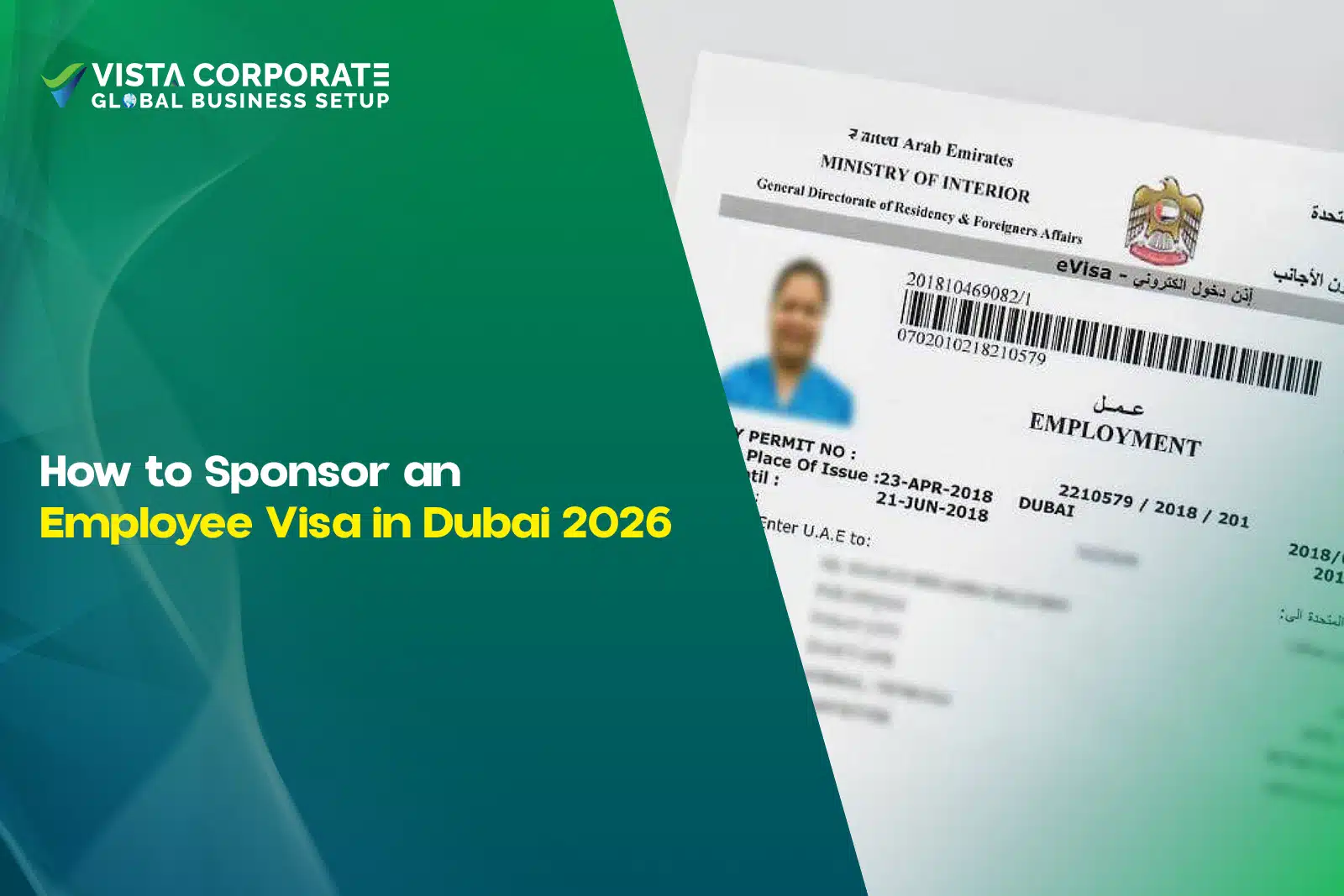
If you’re trying to sponsor an employee visa in Dubai, or you’re an employee trying to understand what your employer is actually doing behind the scenes, this guide walks through the whole thing — what actually happens at each step, what it costs, and where people commonly trip up.
And if you’re here because you’re weighing an investor visa, a Golden Visa, or bringing family over instead of sponsoring an employee — stick around, because a lot of this logic overlaps, and we’ll point you to the right section for your situation too.
What Does “Sponsoring” a Visa in Dubai Actually Mean?
In the UAE, nobody just “gets” a residence visa on their own — someone or something has to vouch for them. That’s sponsorship.
It’s a legal relationship where the sponsor (an employer, a family member, or the person themselves under certain routes) takes responsibility for the visa holder for the duration of their stay. The sponsor’s name sits on the visa, and if something goes wrong — an unpaid fine, an overstay — the sponsor can be held accountable too. This isn’t a technicality; it’s the backbone of how the UAE immigration system actually works.
For employee visa sponsorship in Dubai, the responsibility lies with the employer. Once a company hires a foreign national, it becomes legally obligated to sponsor that person’s residence visa — covering the process, the fees, and ongoing compliance for as long as they’re employed.
Who Can Actually Sponsor an Employee Visa in Dubai?
Not every company can sponsor visas the moment it registers. There’s a checklist behind the scenes, and missing any piece of it is usually why applications stall.
To sponsor an employee, a company needs:
- An active, valid trade license — expired or suspended licenses cannot sponsor employees
- MOHRE registration as an established employer
- A clean labour-law compliance record — no unresolved violations
- Demonstrated financial stability, meaning the ability to actually pay wages
- Available visa quota — you can’t sponsor beyond what your license and office space allow
- Active WPS (Wages Protection System) participation — if your salary payments aren’t running through WPS, new work permits can get blocked
That quota point trips people up more than anything else. Your allowed number of employee visas is tied directly to your license type and the size of your office space — so a company that’s hiring faster than it’s expanding its footprint can hit a wall it didn’t see coming.
What Types of Visas Can an Employer (or You) Sponsor?
Sponsoring an employee visa in the UAE is the most common route, but it’s not the only door into residency.
Here’s the full landscape, since a lot of readers land here weighing more than one option:
| Visa Type | Who It’s For | Typical Duration |
| Employment Visa | Full-time staff tied to a company’s trade license | 2 years |
| Investor / Partner Visa | Business owners or shareholders actively involved in running the business | Tied to company structure; long-term options via Golden Visa |
| Dependent Visa | Spouses and children of a sponsored employee or investor | Matches the sponsor’s visa validity |
| Freelancer / Self-Employment Visa | Independent professionals working under a freelance permit | 1–5 years depending on the route |
| Green Visa | Skilled professionals and freelancers who don’t need an employer | 5 years, self-sponsored |
| Golden Visa | Investors, entrepreneurs, exceptional talent, top students | 10 years |
If your searches keep landing you between “employee visa” and “investor visa,” here’s the quick distinction: an employment visa ties your residency to a company that employs you, while an investor visa ties it to a company you own or actively run. Both fall under employer-style sponsorship in a broad sense, but the eligibility and paperwork differ meaningfully.
Also Read: Investor Visa in Dubai, UAE: A Strategic Guide for Entrepreneurs & Property Investors (2026)
How to Sponsor an Employee Visa in Dubai: The Step-by-Step Process
This is the part everyone actually wants to know.
Step 1: Confirm quota and initial approval. The employer applies through MOHRE (via the Tas’heel system) or the relevant free zone authority for work permit approval, submitting the employee’s documents.
Step 2: Entry permit issued. Once approved, an entry permit is issued electronically. Per the UAE’s official immigration authority (ICP), the visa holder must enter the UAE within 60 days of the permit’s issuance date — and once inside, the residency process must be completed within that same 60-day window, or overstay fines will apply.
Step 3: Employee travels to the UAE. They can enter through any UAE airport or land border once the entry permit is active.
Step 4: Medical fitness test. This is conducted at an approved health centre, screening for a standard panel including tuberculosis and other communicable diseases.
Step 5: Emirates ID application. The employee visits an Emirates ID centre for biometric data collection.
Step 6: Residence visa stamping. With medical clearance and Emirates ID processing underway, the visa gets stamped into the passport — the final legal step confirming UAE residency.
Step 7: Labour card issued. MOHRE issues the digital work permit (labour card), and employment officially begins under full legal compliance.
Realistic total timeline: Most visa sponsorships complete in 2 to 6 weeks, depending on how quickly documents move through each stage and whether any step needs to be redone. However, keep in mind that it could vary from case to case — nationality-specific approval requirements, quota availability at the time of application, how efficiently a company’s HR or PRO team manages the paperwork, and even seasonal processing volume at government centres can all push this timeline shorter or longer. Treat these figures as a realistic planning range, not a guarantee.
What Documents Do You Actually Need?
Split this into two piles, because both sides get checked separately — a strong employee file with a weak employer file (or vice versa) can still cause delays.
From the employer:
- Valid trade license copy
- Establishment card (the company’s official immigration profile)
- Signed employment contract, registered with MOHRE
- Proof of available visa quota
From the employee:
- Passport valid for at least 6 months from the date of entry
- Passport-sized photograph on a white background
- Attested educational certificates (required for certain roles — attestation typically runs through the home country’s Ministry of Education, Ministry of Foreign Affairs, the UAE Embassy abroad, or the UAE Ministry of Foreign Affairs)
- Professional certificates, where applicable
- Previous employment letters, where applicable
- Certificate of good conduct, attested as required
- Medical fitness certificate (obtained during the process, not beforehand)
How Much Does It Cost to Sponsor an Employee Visa in Dubai?
Costs vary by nationality, company category, and whether you’re going through a free zone or MOHRE directly. As a realistic planning figure, most employers should budget between AED 3,000 and AED 7,000 per employee, covering the entry permit, medical test, Emirates ID, visa stamping, work permit, and any agent or typing centre service charges.
It’s also worth being clear on where this financial responsibility actually sits. Federal Decree-Law No. 33 of 2021, which governs employment relationships in the UAE, places the full cost of sponsorship squarely on the employer’s shoulders — meaning visa and recruitment-related expenses cannot legally be passed on to the employee through salary deductions or reimbursement demands. Structuring your budget with this in mind from the outset avoids a compliance issue that can otherwise catch employers off guard later.
What Are Employers Legally Required to Do — and Not Do?
Sponsorship isn’t just a one-time application; it comes with ongoing legal obligations.
Employers must:
- Cover all visa processing fees
- Pay for the employee’s medical examination
- Process and pay for the Emirates ID
- Arrange mandatory health insurance before the visa is finalised
- Obtain and maintain a valid work permit
- Register the employment contract with MOHRE
Employers must never:
- Charge employees for their own visa costs
- Retain an employee’s passport
- Withhold wages
- Employ anyone without a valid work permit
- Transfer someone’s sponsorship to another employer without their consent
That last point matters more than people assume — passport confiscation and visa-cost deductions from salary are both illegal under UAE labour law, no matter how common the practice might seem informally.
Can You Sponsor Family Members Too?
Yes, you can — and this is usually where things get a little confusing, because people start Googling “employee visa vs investor visa vs family visa” and end up more lost than when they started. So let’s untangle it.
Once you’re holding a valid employment visa, you can generally bring over your spouse (any nationality, no restrictions there), your sons up to age 25 (that got bumped up from 18 recently, which is a nice change if you’ve got a college-age kid), your daughters at any age as long as they’re unmarried, and your parents through a separate application.
Why Family Sponsorship Got a Bit Easier in 2025
Good news first: 2025 brought some real quality-of-life improvements here. The ICP lowered salary requirements for some sponsor categories, and processing through their online portal now typically takes just 3–5 working days instead of dragging on. You apply digitally, your entry permit shows up by email, and the days of trekking to a government office three separate times are mostly behind us.
So, What Salary Do You Actually Need?
Here’s where people get tripped up, because the number isn’t one-size-fits-all — it depends entirely on who you’re bringing over.
Sponsoring your spouse and kids is fairly straightforward: you’ll need a minimum monthly salary of AED 4,000 if you’re paying for your own accommodation, or AED 3,000 if your employer covers housing as part of your package. Not too demanding, relatively speaking.
Parents, though? That’s where it gets genuinely complicated — and honestly, we’d rather be upfront about the confusion than pretend there’s a clean answer.
GDRFA’s own federal humanitarian portal lists a baseline of AED 10,000 for parent sponsorship. Sounds simple, right? Except that figure is meant specifically for discretionary humanitarian cases, assessed one by one — not a general rule you can just plug into a standard application. In everyday practice, GDRFA Dubai has typically stuck with a much higher bar of AED 20,000 for routine parent-sponsorship approvals. So which number applies to you really comes down to which pathway your case falls under, and mixing the two up is a genuinely easy mistake to make if you’re just going off one article you found online (including this one, honestly).
If you miss the salary requirement that actually applies to your situation, then you’re looking at a rejection at document review — with your fee likely gone for good. Not exactly the outcome you want after gathering a stack of paperwork.
If you’re self-employed, proving your income looks a bit different. You won’t have a typical salary slip from an employer, so you’ll need either audited financial statements. If you’re running things through a free zone license — a salary certificate that reflects what you personally draw is required.
Here’s how that plays out in real life: Let’s say you’re a marketing consultant working under a Dubai free zone company license, and you draw a declared salary of AED 4,800 a month. You can get a salary certificate from your free zone confirming that number, and you’ve comfortably cleared the AED 4,000 threshold to sponsor your spouse — no extra paperwork needed beyond that one certificate.
Given how tangled the parent-sponsorship numbers can get — different portals, different emirates, different case types — this is genuinely one of those moments where it’s worth just picking up the phone and talking to a PRO (Public Relations Officer) before you submit anything. They’ll know exactly which threshold your specific case falls under, and that one conversation could save you a non-refundable fee and a lot of frustration.
What’s Changed in UAE Visa Sponsorship Recently?
A few updates worth knowing if you haven’t sponsored a visa in the last year or two:
- Standardised overstay fines. As of February 2026, overstay penalties were unified at AED 50 per day across all seven emirates, replacing a patchwork of emirate-specific rates. A one-time AED 200 administrative penalty applies on top, and after six months of overstay, an additional AED 500 monthly fine kicks in.
- Reduced NOC requirements. Switching employers within the UAE increasingly no longer requires a No Objection Certificate from the previous employer — a meaningful shift from how job mobility used to work.
- More digital processing. A growing share of the sponsorship journey — document verification, applications, even health insurance arrangement — is now handled through fully digital platforms rather than in-person government visits.
What Happens If a Visa Isn’t Renewed or Cancelled Properly?
Two separate risks here, and both land partly on the employer.
Late renewal: Employers need to initiate renewal at least 30 days before expiry. Miss that window and daily overstay fines apply — AED 50 per day is the standardised rate as of the 2026 update, though some guidance describes fines escalating to AED 100/day after an extended period, with a maximum exposure well into the tens of thousands of dirhams plus a possible entry ban.
Improper cancellation: When employment ends, the employer must formally cancel the work permit and residence visa, typically within 30 days. Skip this step, and the company risks fines in the range of AED 5,000–10,000, plus potential blocklisting from sponsoring future hires. On the employee side, proper cancellation should still include full final settlement, any contractual gratuity, a return ticket if specified in the contract, and a certificate of employment.
Employee Visa vs. Investor Visa vs. Golden Visa: Which One Fits You?
Since plenty of people land on this page trying to figure out which route applies to them, here’s the short version:
- Hired by a UAE company? You need employer sponsorship — the standard employee visa route covered throughout this guide.
- Starting or actively running your own business? You’re likely looking at an Investor/Partner visa, sponsored through your own company’s license.
- High-value investor, entrepreneur, or specialist with a strong track record? The Golden Visa may be the better long-term fit — especially if you want to avoid being tied to a single employer.
- Freelancer or remote professional working for a company outside the UAE? Self-sponsored routes like the Green Visa or freelance permits let you sponsor yourself without needing an employer at all.
How Vista Business Setup Can Help
Reading through all of this probably makes one thing pretty clear: sponsoring a visa in Dubai isn’t hard because any single step is complicated — it’s hard because there are so many moving pieces, and getting even one of them slightly wrong (a mismatched salary certificate, a missed quota check, the wrong threshold for a parent’s application) can cost you time, money, or both.
This is exactly the gap our team at Vista exists to close. We’ve got a team of business setup consultants and PRO specialists who handle this process day in and day out — not as a side service, but as the core of what we do. Here’s what that actually looks like in practice:
- We check your eligibility before you file, not after. Whether it’s confirming your visa quota, verifying which salary threshold applies to your specific family-sponsorship case, or making sure your trade license actually covers the sponsorship you’re trying to do — we catch the mismatches that lead to rejections before they cost you a non-refundable fee.
- Our PRO specialists handle the government-facing legwork. From MOHRE and Tas’heel applications to ICP and GDRFA submissions, we manage the paperwork, the portals, and the follow-ups, so you’re not the one chasing status updates or figuring out which document format an authority wants this week.
- We stay current on the changes that actually matter. Salary thresholds shift, portals get reformed, and requirements vary depending on which pathway your case falls under — we track that so you don’t have to piece it together from scattered sources.
- We support the full picture, not just one visa. Whether you’re sponsoring your first employee, bringing over a spouse and kids, or figuring out whether an investor visa or Golden Visa route makes more sense for your situation long-term, we help you map the right path from the start rather than course-correcting later.
Basically, our job is to take the parts of this process that are easy to get subtly wrong and make sure you get them right the first time.
Final Thoughts
Sponsoring a visa in Dubai — whether it’s for an employee, a spouse, or a parent — really comes down to two things: knowing exactly which rules apply to your specific situation, and getting your documentation right before you submit, not after. The process itself isn’t unreasonable once you understand it, but the details genuinely do shift depending on your visa type, your relationship to the person you’re sponsoring, and sometimes even which government channel your case runs through.
If there’s one takeaway to carry forward, it’s this: don’t assume the number or the process you read about online applies universally to your case. A quick check with someone who does this daily can save you a rejected application, a lost fee, and a lot of unnecessary back-and-forth.
Ready to sponsor an employee, bring your family over, or figure out which visa route actually fits your situation? Get in touch with our team at Vista — we’ll walk through your specific case, confirm exactly what you need, and handle the process end to end, so you can focus on everything else that comes with building a life or a business in Dubai.
Search
Recent Post

 2 Oct 2026