 27 Jun 2025
 By Vista Corp
Starting a business in the UAE is not just a registration process.
It is a strategy decision.
Because the UAE does not offer entrepreneurs a single route. It offers them options: mainland, free zone, offshore, commercial licences, professional licences, industrial licences, investor visas, employee visas, digital government services, international banking, tax frameworks, and access to some of the world’s most active markets.
That flexibility is powerful. But it can also be confusing.
A founder may know exactly what business they want to start, but still feel lost when choosing the right activity, authority, legal structure, office package, visa plan, and compliance route. That is why starting a business in the UAE should never begin with “Which licence is cheapest?” It should begin with “Which structure supports my business properly?”
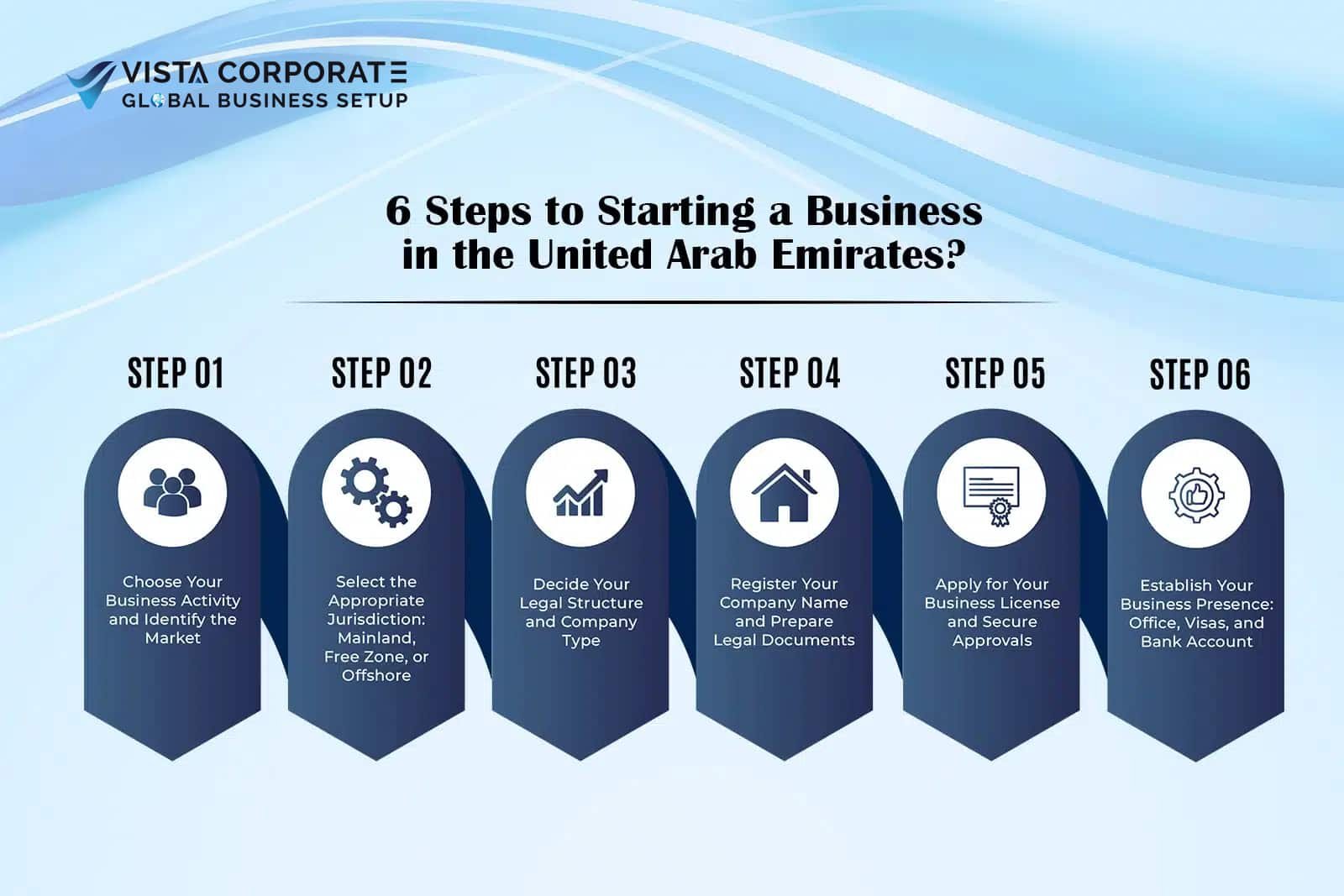
Here are the 6 essential steps to starting a business in the United Arab Emirates, written for entrepreneurs who want to start smart, stay compliant, and build with confidence.
Step 1: Define Your Business Activity Clearly
The first step is deciding what your company will legally do.
This may sound simple, but it is one of the most important decisions in UAE company formation. Your business activity affects your licence type, jurisdiction, legal form, approvals, office needs, visa eligibility, tax treatment, banking profile, and future expansion.
A web development company, trading business, restaurant, real estate brokerage, tourism agency, consultancy, manufacturing unit, and e-commerce brand will not follow the same setup route. Some activities are simple. Some need external approvals. Some are better suited to the mainland. Some work better in a free zone. Some may need product registrations, professional certificates, inspections, or sector-specific permissions.
The UAE government lists identifying the business activity as one of the first steps in mainland setup, before choosing the legal form, registering the trade name, obtaining initial approval, and completing licence requirements. The Ministry of Economy also states that the company formation journey begins with identifying the business activity and legal structure.
This is why you should not select an activity just because it sounds close enough. Your activity must align with your actual operations. If you plan to sell products, provide consultancy, develop software, import goods, open a shop, or offer tourism services, the licence should clearly support that.
Start with clarity. It saves time, money, and stress later.
Step 2: Choose the Right Jurisdiction
Once the activity is clear, the next step is choosing where to set up the company.
In the UAE, most investors choose between mainland, free zone, or offshore structures. Each has a different purpose.
A mainland company is often suitable for businesses that want to trade directly within the UAE, serve local clients, open a physical shop or office, hire employees, and build a wider onshore presence. Invest in Dubai describes mainland company setup as the route for businesses looking to trade within the UAE or those that prefer not to operate from a free zone.
A free zone company may be suitable for international trade, digital services, consultancy, e-commerce, import-export, professional services, startups, and sector-focused operations. Free zones often provide flexible office options, visa packages, streamlined licensing, and business communities.
An offshore company is usually used for international structuring, asset holding, or cross-border planning where suitable. It is not the same as an operating company with standard UAE office activity and employee visas.
The best jurisdiction depends on your business model. If your clients are mainly UAE mainland clients, the mainland may be more practical. If your services are mostly international or digital, a free zone may work well. If your purpose is to hold assets or for international structuring, offshore options may be reviewed carefully.
The mistake is choosing based only on package price. The smarter move is choosing based on how the business will actually operate.
Step 3: Select the Legal Structure and Trade Name
After choosing the jurisdiction, you need to select the legal structure.
Your legal structure defines ownership, liability, shareholder rights, management powers, signing authority, and the rules your company must follow. A solo entrepreneur may need a different structure from a company with multiple shareholders. A foreign company opening a presence in the UAE may need a branch or a subsidiary. A trading business may need a different structure from a professional consultancy.
The Ministry of Economy explains that a company’s legal structure depends on the nature and requirements of the business and determines which laws and regulations apply. It also states that a trade name must match the economic activity and include the legal form abbreviation, such as LLC, where applicable.
Your trade name is your company’s official identity. It should be available, professional, compliant with UAE naming rules, and suitable for your future growth.
Many entrepreneurs make the mistake of building a full brand before checking if the name can be registered. They create the logo, website, Instagram handle, and business cards first, then discover that the name is unavailable or does not comply with naming rules.
Check the trade name early. A good name should not only sound attractive but also be legally permissible and scalable.
Step 4: Apply for Initial Approval and Prepare Documents
Initial approval usually means the relevant authority has no objection to you continuing with the company formation process, subject to completing the remaining steps.
This does not always mean you can start operating immediately. You may still need to finalise legal documents, office arrangements, external approvals, licence issuance, immigration registration, and other requirements.
Documents depend on the jurisdiction, activity, legal structure, and type of shareholder. Individual shareholders may need passport copies, visa or entry stamp copies where applicable, Emirates ID for UAE residents, photographs, selected activities, and application forms. Corporate shareholders may need attested and legalised company documents, board resolutions, certificates of incorporation, and constitutional documents.
Some activities may require additional approvals. This can apply to sectors such as food, healthcare, education, tourism, real estate, construction, transport, industrial activity, engineering, legal services, and financial services.
The UAE mainland setup process includes preparing required documents, selecting a business location, and obtaining additional government approvals where required.
This step is where professional support can save time. A missing attestation, an incorrect shareholder document, a rejected activity, a name mismatch, or an incomplete approval file can unnecessarily delay the process.
Step 5: Secure Office Space and Obtain the Business Licence
Your office or business location depends on your company type, activities, jurisdiction, visa requirements, and applicable regulations.
A mainland company may need an office, shop, warehouse, restaurant space, clinic, industrial unit, or another suitable location, depending on the activity. A free zone company may offer flexi-desk, shared-desk, serviced-office, private-office, warehouse, or industrial-space options.
Office space is not only about where you work. It can affect your licence approval, visa quota, banking profile, inspections, client credibility, and renewals.
A consultant may not need the same setup as a retail store. A trading company may need storage or customs planning. A restaurant needs a physical location with authority approvals. A business planning to hire employees must consider visa eligibility before choosing the office package.
Once the activity, legal structure, name, documents, office requirements, and approvals are completed, the authority can issue the business licence.
This is the milestone most entrepreneurs wait for. But it is not the end of the journey. It is the point at which the company becomes legally established and begins operations.
Step 6: Complete Visas, Banking, Tax, and Compliance
The final step is making the company operational.
If the owner wants to live in the UAE or the company plans to hire employees, visa planning is essential. Depending on the jurisdiction and structure, the company may support investor visas, partner visas, employee visas, and, where eligible, dependent visas.
Banking also needs preparation. A UAE business bank account is not automatically guaranteed just because a licence is issued. Banks usually review the company’s activity, ownership structure, shareholder background, source of funds, expected transactions, client profile, supplier details, office presence, contracts, invoices, and business model.
Tax and accounting should also be considered from the beginning. For VAT, the Federal Tax Authority states that UAE-resident businesses must register if taxable supplies and imports exceed AED 375,000 over the past 12 months or are expected to exceed that threshold within the next 30 days. Voluntary registration may apply when taxable supplies, imports, or taxable expenses exceed AED 187,500.
Corporate tax registration, bookkeeping, invoicing, financial records, renewals, and compliance responsibilities should also be planned early. Even if the company is new, accounting should begin from the first transaction.
This is what turns a company from “registered” into “ready.”
Why Professional Business Setup Support Matters
Starting a business in the UAE involves connected decisions.
Your activity affects your licence. Your licence affects your jurisdiction. Your jurisdiction affects your office and visas. Your activity and structure affect banking. Your transactions affect VAT and tax obligations. Your records affect compliance.
That is why professional business setup support can help entrepreneurs avoid wrong turns.
A business setup consultant helps with activity selection, mainland and free zone comparison, legal structure guidance, trade name reservation, document preparation, approval coordination, licence issuance, visa support, PRO services, renewals, and post-setup guidance.
The goal is not only to get the licence. The goal is to build a company that can operate properly.
Why Choose Vista Global Business Setup?
Vista Global Business Setup helps entrepreneurs, startups, SMEs, investors, and international companies start businesses in the UAE with end-to-end guidance.
The team supports clients with business activity selection, mainland and free zone company formation, licence guidance, trade name reservation, documentation, approvals, visa assistance, PRO services, renewals, and post-setup support.
Whether you are launching a consultancy, trading company, e-commerce business, tourism firm, professional service company, branch office, or mainland LLC, Vista helps simplify the setup journey and build the right foundation.
The 6 steps to starting a business in the United Arab Emirates are simple when approached in the right order.
Define your activity. Choose the right jurisdiction. Select the legal structure and trade name. Apply for initial approval and prepare documents. Secure office space and obtain the licence. Then complete visas, banking, tax, accounting, and compliance.
The UAE gives entrepreneurs one of the strongest business platforms in the world. But the setup must match the business model.
A licence starts the company. The right process prepares it for growth.
Vista Global Business Setup helps entrepreneurs start a business in the UAE with expert licensing guidance, documentation support, visa assistance, PRO services, and complete company formation solutions.
Search
Recent Post


 2 Oct 2026