 20 Jan 2026
 By Vista Corp
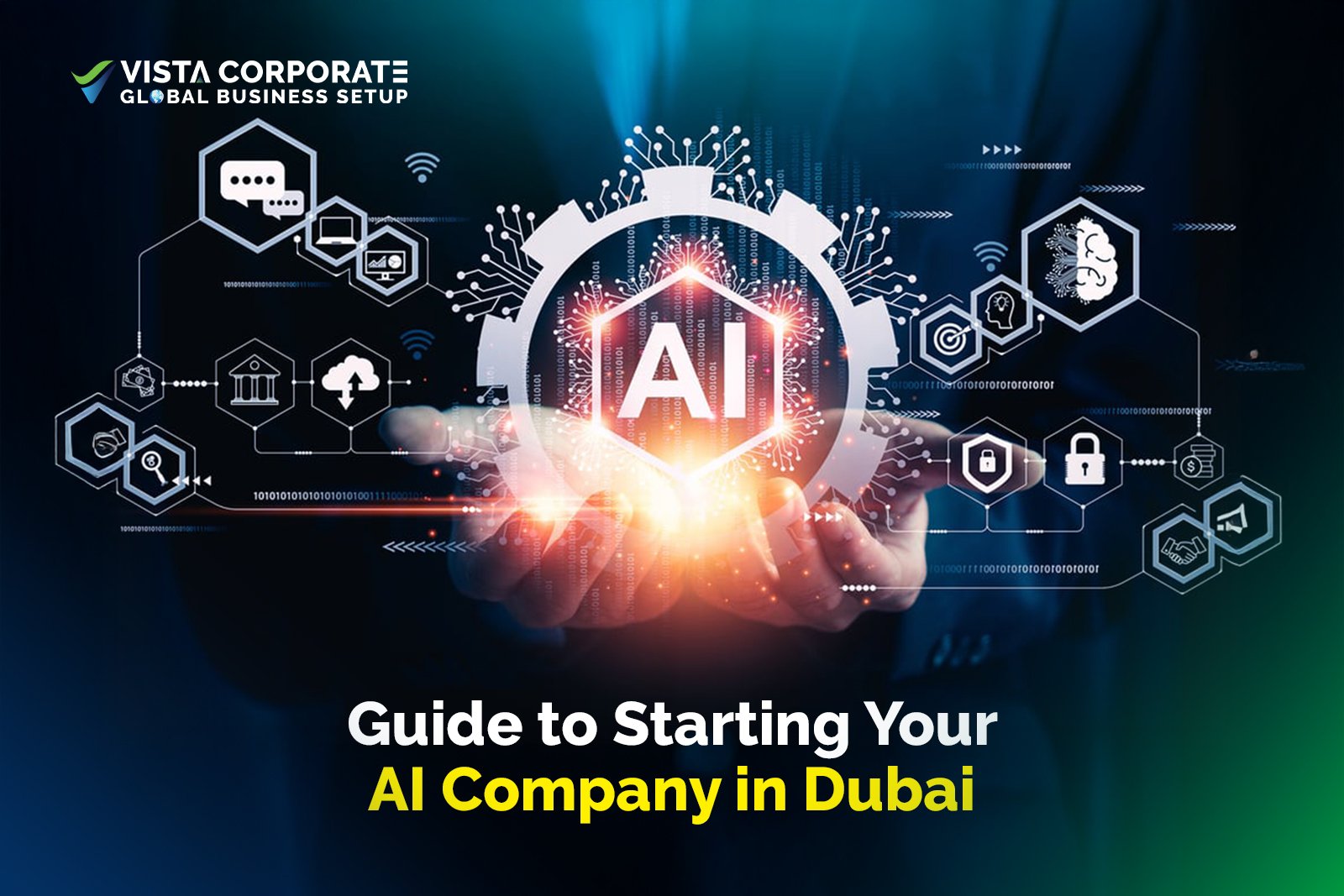
Dubai is no longer just a place to adopt artificial intelligence. It has become a place to build it.
In 2026, the city is home to more than 1,100 AI startups, ranging from early research-driven teams to fast-growing global scale-ups. This growth is not accidental. The UAE’s AI market is already valued at around $4.6 billion and is projected to grow steadily toward $46 billion by 2030, backed by strong government vision, private investment, and real-world adoption across industries.
What truly sets Dubai apart is talent. Today, Dubai ranks #1 globally in AI talent readiness and adoption. This position has been strengthened by long-term residency initiatives, such as the Golden Visa for digital technology professionals, which have attracted thousands of engineers, data scientists, and AI founders from Europe and Asia. As a result, companies setting up in Dubai are not just accessing capital and infrastructure, but also one of the most concentrated AI talent pools in the world.
For entrepreneurs and innovators, this creates a rare opportunity. Whether you are building AI-driven software, enterprise solutions, platforms, or data products, the ecosystem is designed to support innovation from idea to scale.
This guide is written for founders, investors, and professionals who want to start an AI Company in Dubai and do it the right way: clearly, legally, and with long-term growth in mind.
Understanding AI Business in Dubai
An AI business in Dubai is any company that uses artificial intelligence to solve real problems or improve how work is done. This could be software that analyses data, automates decisions, predicts outcomes, or personalises customer experiences. Dubai encourages AI not just as a technology, but as a practical business tool.
For example, an AI company might build a system that helps retailers predict demand, hospitals analyse patient data faster, or banks detect fraud automatically. These are not experimental ideas; they are active, commercial solutions already being used in Dubai. The government’s AI-first approach makes it easier for such businesses to launch, test, and scale responsibly.
Why Dubai is an Ideal Market to Start Your AI Company
Dubai is not experimenting with AI anymore. It is actively building an economy around it. Here are 10 clear reasons why founders are choosing Dubai for their AI ventures.
1. The Government Is an Active AI Customer
In Dubai, the government does not just regulate AI; it uses it. Most government departments have dedicated AI leaders focused on automation and innovation. This creates real opportunities for AI startups to work directly with public-sector entities on real problems like traffic, healthcare, security, and city planning.
2. Strong Computing Infrastructure
AI companies need serious computing power. The UAE is investing heavily in large-scale AI infrastructure, reducing dependence on overseas cloud providers. This makes it easier for startups to train models, process data, and scale without facing global hardware shortages.
3. Dedicated AI Business Licenses
Dubai offers specific commercial licenses for AI-focused businesses. These licenses clearly define permitted activities, making compliance simpler. Some innovation hubs also offer incentives and support, lowering the entry barrier for early-stage founders.
4. Long-Term Residency for AI Talent
Dubai attracts global AI talent through long-term residency options. Engineers, data scientists, and founders can relocate without visa uncertainty, making it easier to build stable, long-term teams.
5. Regulatory Sandboxes for Testing AI
Some AI products involve higher regulatory risk, such as fintech or mobility solutions. Dubai allows controlled testing through regulatory sandboxes, letting companies experiment legally while working closely with authorities.
6. Access to the Arabic-Speaking Market
Dubai is a gateway to a large Arabic-speaking population. Many global AI tools are not fully localised, creating strong demand for region-specific AI solutions in language processing, customer service, and analytics.
7. Availability of Capital for AI Startups
Dubai is home to major investment funds actively looking for technology and AI opportunities. In 2026, there is a strong availability of capital ready to back AI-driven businesses with solid use cases.
8. Clear Data and AI Regulations
Dubai has introduced modern data protection and AI governance rules. Clear regulations help AI companies build trust with clients, especially enterprises that care about data security and ethical AI use.
9. Strategic Location for Global Expansion
Dubai connects Europe, Asia, Africa, and the Middle East. From one base, AI companies can serve multiple markets efficiently, making it ideal for regional and global expansion.
10. An AI-Driven Lifestyle and Ecosystem
AI is visible everywhere in Dubai, from smart transport to automated services. Regular AI events, conferences, and networking opportunities help founders stay inspired, connected, and informed.
AI Business Models You Can Launch in Dubai (2026)
Here are the 10 most promising AI business models currently booming in Dubai:
1. AI-Driven PropTech (Predictive Valuation & Yield)
With the DLD Strategic Plan 2026 focusing on transparency, AI models that integrate with Land Department data to provide “Live Market Valuations” and “Predictive Rental Yields” are in high demand.
- The Model: SaaS for investors and brokers that predicts which off-plan project will yield the highest capital appreciation based on historical and real-time transit data (like the new Metro Blue Line).
2. Arabic-First LLM Customisation (NLP)
Western AI models often struggle with the nuances of local Arabic dialects (Khaleeji). Following the success of local models like Jais 2, there is a gap for companies that “fine-tune” these models for local industries.
- The Model: B2B service for banks and government agencies to build culturally accurate, Arabic-speaking customer service agents and legal document analysers.
3. AI for Smart Living & Luxury Real Estate
“Smart homes” are now a standard expectation for 2026 buyers. However, the boom is in Intelligent Living Systems that go beyond simple automation.
- The Model: Installing and managing AI systems in luxury villas that learn resident behaviour to optimise energy by up to 40% and provide “Security Beyond Surveillance” (behavioural anomaly detection).
4. Logistics “Co-Pilots” for Last-Mile Delivery
As Dubai aims to become a top 3 global economic hub, logistics efficiency is critical. AI systems that handle autonomous shipment rerouting in real-time are booming.
- The Model: AI software that integrates with delivery fleets to predict traffic, weather, and port delays, automatically rebalancing inventory across “dark stores” in areas like Dubai South.
5. EdTech: AI-Augmented “Cinematic” Learning
The UAE education sector is moving toward personalised, neuroscience-backed learning. The trend in 2026 is HMC (Human-Machine Collaboration) in classrooms.
- The Model: Platforms that use AI to create “personalised learning journeys” for students, turning static curriculum into interactive, cinematic experiences that adapt to each child’s pace.
6. AI-Powered Sustainable Infrastructure (GreenTech)
With the UAE’s net-zero goals, companies that use AI to monitor and reduce the carbon footprint of commercial buildings are seeing huge government support.
- The Model: Real-time Carbon Tracking for developers and manufacturers, providing automated “Green Building” compliance reports to meet 2026 sustainability regulations.
7. HealthTech: AI Diagnostic & Wellness Platforms
Dubai is positioning itself as a leader in “Longevity” and “Predictive Healthcare.”
- The Model: AI platforms for clinics that interpret diagnostics (Radiology/Genomics) to develop personalised wellness protocols. There is a specific boom in Virtual Medical Managers for chronic disease management.
8. Cybersecurity for AI-Native Entities
As more businesses move their operations to AI, the risk of “Model Poisoning” and AI-driven cyberattacks has increased.
- The Model: Specialised cybersecurity firms that focus on AI Audit & Defence, protecting local companies from deepfakes, data leaks, and adversarial attacks on their proprietary models.
9. Fractional Real Estate Tokenisation (PropTech)
While PropTech is broad, the 2026 standout is AI-managed fractional ownership.
- The Model: A platform where AI handles the “smart-sourcing” of properties, and investors buy “tokens” of the unit. The AI manages the tenancy, rent collection, and maintenance automatically via blockchain.
10. “Ethics-as-a-Service” (AI Governance)
With the UAE’s focus on responsible AI use, government and large enterprises now require Ethical Audits to ensure their AI isn’t biased.
- The Model: Consultancy firms that use proprietary software to audit a company’s AI algorithms for fairness, security, and privacy, providing the “Dubai AI Trust Seal.”
Main License Types for AI Businesses in the UAE
Choosing the right license is one of the most important steps when launching an AI company. In the UAE, AI businesses are usually classified based on what they sell, like services, software products, online platforms, or advanced research. Below are the four core license categories you should understand before moving forward.
1. Professional License (For Service-Based AI Companies)
A Professional License is ideal for AI businesses that sell expertise and services, not physical or digital products. This license suits founders who offer custom solutions, consulting, or project-based AI work.
Under this license, companies typically provide AI strategy consulting, data analytics services, custom machine learning model development, AI-powered forecasting tools, and corporate AI training programs. You are essentially selling knowledge, skills, and implementation support.
This license is a top choice because it is widely available, allows full foreign ownership, and is straightforward to maintain. It works especially well for consultants, freelancers, and boutique AI solution providers serving enterprises or government clients.
2. Technology / IT Services License (For AI Products & Software)
If your AI company is building its own technology or software, this license is essential. It covers businesses that develop, sell, or license proprietary AI platforms and tools.
This includes AI software and SaaS platforms, automation tools, robotics software, intelligent systems, and algorithm development services. Your core value here is the technology itself, not just the service around it.
This license is commonly issued in tech-focused zones such as Dubai Internet City and Dubai Silicon Oasis. It is best suited for AI startups, SaaS founders, and companies planning to scale technology products globally.
3. E-Commerce License (For Online AI Products)
An E-Commerce License is required if your AI product is sold online as a digital offering. This applies even if no physical goods are involved.
Businesses using this license usually sell subscription-based AI platforms, online AI tools like content generators, API access to AI models, or downloadable software. In many cases, this license is combined with a Technology License to cover both development and online sales.
Several innovation-focused free zones offer this license, making it a practical option for founders targeting global customers through digital channels.
4. Innovation or Specialised AI License (For R&D and Advanced Tech)
Some hubs in the UAE offer specialised licenses designed for advanced AI research and experimentation. These licenses support deep-tech areas such as computer vision, natural language processing, robotics, and next-generation AI systems.
These setups often provide access to regulatory sandboxes, allowing companies to test high-impact or sensitive AI applications in a supervised environment. They also offer direct exposure to accelerators, investors, and government stakeholders.
Leading platforms include DIFC Innovation Hub, Dubai Future Foundation, and Hub71. These are best for founders working on cutting-edge AI with long-term research and scaling ambitions.
Free Zone, Mainland, or Offshore: The Ideal Jurisdiction for an AI Company
One of the most important decisions when setting up an AI company in Dubai is choosing the right jurisdiction. In the UAE, this usually comes down to three options: Mainland, Free Zone, or Offshore. Each serves a very different purpose, and choosing the wrong one can limit how your AI business operates or grows.
Below is a clear, practical breakdown to help you decide.
Mainland (Onshore) Company
A Mainland company setup allows your AI business to operate freely across the UAE, without geographic or client restrictions. This is the only structure that lets you work directly with government entities, large local enterprises, and consumers across the country.
The main strength of a Mainland setup is full market access. You can sign contracts with government departments, provide services on-site, and participate in large-scale national projects.
This structure is best suited for AI companies involved in:
- Smart city and urban technology solutions
- AI-powered logistics and supply chain systems
- Physical security, surveillance, and monitoring solutions
- Healthcare AI implementations and medical technology
- Direct government or semi-government contracts
If your AI business needs a strong on-ground presence and local execution, Mainland is usually the right choice.
Free Zone Company
Free Zones are designed to support innovation, technology, and international business. They offer faster setup, full foreign ownership, and a startup-friendly ecosystem.
The biggest advantage of a Free Zone company setup is simplicity combined with global reach. These zones provide modern infrastructure, access to investors, accelerators, and a strong tech community, making them ideal for AI startups that are building products or serving international clients.
Free Zones work especially well for:
- AI software and SaaS companies
- Data analytics and automation platforms
- FinTech, RegTech, and InsurTech solutions
- R&D-focused AI businesses
- Consulting and service-based AI firms
Popular zones for AI companies include Dubai Internet City, DIFC Innovation Hub, Dubai Silicon Oasis, SRTIP, and ADGM. Each caters to different AI use cases, from software and finance to research and applied technology.
Offshore Company
An Offshore company setup is not designed for active business operations in the UAE. Instead, it is used as a legal and structural tool for international purposes.
The key benefit of an Offshore setup is structural efficiency. It allows founders to separate ownership, assets, and intellectual property from day-to-day operations.
For AI businesses, Offshore companies are commonly used to:
- Hold patents, algorithms, and proprietary software
- Own intellectual property separately from operating entities
- Act as a parent or holding company for global subsidiaries
An Offshore company works best as a supporting structure, not as the main operating business inside the UAE.
How to Choose the Right Option
In simple terms:
- Choose Mainland if your AI company needs local contracts and physical implementation
- Choose a Free Zone if you are building, selling, or scaling AI products globally
- Choose Offshore if your goal is IP holding or international structuring
Many mature AI businesses eventually use a combination of these structures to balance operations, ownership, and expansion.
Step-by-Step Process to Start an AI Company in Dubai
Below is a clear, practical 15-step roadmap to help you launch your AI company in Dubai smoothly, stay compliant, and prepare for long-term growth.
Phase 1: Strategy & Legal Foundation
Step 1: Define Your AI Niche
Clearly describe what your AI company will do. Authorities now differentiate between areas like generative AI, machine learning model training, AI consulting, and automation services.
Step 2: Conduct a Market Feasibility Check
Validate demand for your AI solution in Dubai. Popular sectors include real estate, logistics, finance, healthcare, and government services aligned with the D33 economic agenda.
Step 3: Decide on Mainland vs Free Zone Company Setup
Choose Mainland if you plan to work directly with the UAE government or local companies. Choose Free Zone if you want full ownership, tech-focused incentives, and a global customer base.
Step 4: Select the Legal Structure
Most AI startups choose a Limited Liability Company (LLC) because it supports scaling, banking, and investor entry more easily.
Step 5: Reserve Your Trade Name
Submit three trade name options that reflect your brand and activity. Avoid restricted words like “UAE,” “Federal,” or “National” unless approved.
Phase 2: Licensing & Documentation
Step 6: Apply for Initial Approval
This is the government’s confirmation that your AI business activity is acceptable and can proceed to licensing.
Step 7: Draft the Memorandum of Association (MoA)
The MoA defines ownership structure and company rules. In many cases, notarisation can now be completed digitally.
Step 8: Apply for the AI Business License
Choose the correct license type based on whether you offer AI services, software, or digital platforms. Some tech hubs offer innovation-focused licenses.
Step 9: Obtain Special Approvals (If Required)
If your AI handles sensitive data, healthcare information, or financial systems, additional approvals or NOCs may be required.
Phase 3: Infrastructure & Banking
Step 10: Secure Office Space
Mainland companies require a physical office with Ejari registration. Free Zone companies may opt for flexi-desks or virtual offices.
Step 11: Finalise Company Registration
Pay final license fees and receive your commercial registration and trade license.
Step 12: Open a Corporate Bank Account
Start with digital-first banks for quicker onboarding, then expand to a traditional bank account opening as your operations grow.
Phase 4: Residency & Operations
Step 13: Apply for the Establishment Card
This registers your company with labour authorities and allows you to sponsor residence visas.
Step 14: Apply for Residence Visas or Golden Visa
As an AI founder or specialist, you may qualify for a 10-year Golden Visa, offering long-term stability and independence.
Step 15: Register for Corporate Tax and VAT
Register with the Federal Tax Authority within the required timeline, even if your business is below the taxable threshold. Corporate tax filing is a strict regulation in the UAE.
Also Read: What Is an Establishment Card in the UAE and Why Every Business Needs One
7 Bottlenecks to Watch Out For
Starting an AI company in Dubai is a strong opportunity, but like any serious venture, it comes with real challenges. Below are seven genuine bottlenecks founders commonly face, and should plan for early.
1. Choosing the Wrong Business Activity
The Bottleneck: It’s no longer just about generic wording. In 2026, the DET (Department of Economy and Tourism) introduced “Risk-Based Activity Codes.”
- The 2026 Twist: If you choose an activity like “AI in Healthcare” vs. “AI Software Development,” you trigger a mandatory audit path from the Dubai Health Authority (DHA). Choosing the wrong code doesn’t just delay you; it can lock you into expensive, unnecessary regulatory oversight.
2. Misalignment Between License and Operations
The Bottleneck: This is a classic “Banking Killer.”
- The Challenge: If your license says “Consulting” but your website shows a “SaaS Platform,” banks will flag you for “Unlicensed Financial Activity” (if you’re taking subscriptions). In 2026, banks use AI-driven crawlers to check your website against your license. If they don’t match, your account can be frozen within 48 hours.
3. Banking Delays for AI Companies
The Bottleneck: This remains the #1 hurdle.
- The 2026 Reality: Banks now require an “AI Business Model Disclosure.” They want to know where your data comes from and where it is stored. If you use “Open Source” models without clear data-origin documentation, compliance departments may label you “High Risk” due to potential IP or data-sovereignty violations.
4. Data & Compliance Blind Spots
The Bottleneck: The UAE PDPL (Personal Data Protection Law) and the new Child Digital Safety Law (effective Jan 2026).
- The Challenge: You cannot simply “move” data to a cloud server in Europe anymore without specific safeguards. If your AI processes data of UAE residents, you must ensure Data Localisation compliance. Missing this isn’t just a bottleneck; it’s a legal liability with fines starting at AED 20,000.
5. Underestimating Visa Planning
The Bottleneck: The “Title vs. Reality” gap.
- The Challenge: To get a Golden Visa for your staff, their job title on the contract must match a specific list of “Level 1” professions. If you hire a “Prompt Engineer” (a title that might not be in the government system yet), they might only qualify for a standard 2-year visa. You need to map job titles to the MOHRE classification before you hire.
6. Overpaying for Office Space Too Early
The Bottleneck: The “Visa-to-Square-Foot” ratio.
- The Challenge: In Dubai, your office size traditionally dictated how many people you could hire.
- The 2026 Hack: Many Free Zones now offer “Green Visas” and “AI Work Permits” that are decoupled from physical square footage. If you don’t know this, you might rent a 1,000 sq. ft. office you don’t need just to get 4 visas.
7. Assuming “AI” Alone Sells (The “Wrapper” Trap)
The Bottleneck: The “Thin-Wrapper” scepticism.
- The Challenge: Investors and government departments in 2026 are wary of “GPT-wrappers”, companies that just put a UI on top of someone else’s model.
- The Reality: To win contracts or funding in Dubai now, you must demonstrate “Algorithmic Accountability.” You need to show how your AI reaches its conclusions to prove it isn’t just a black box of biased data.
Documents Required to Register Your Dubai AI Company
Getting your documents ready early can save you weeks of back-and-forth during company registration. While the exact requirements may vary slightly depending on whether you choose Mainland or Free Zone, the core documents remain largely the same.
A. Personal Documents (For All Shareholders and Managers)
These documents confirm who is behind the company and its legal status.
- Passport Copies: Clear, colour copies of the passport information page for all shareholders and the appointed manager. Passports should be valid for at least six months.
- Passport-Size Photographs: Recent photographs with a white background, following UAE visa standards.
- UAE Entry or Residency Proof: If you are outside the UAE, a copy of your latest entry stamp is required. If you are already a resident, submit a copy of your UAE residence visa and Emirates ID.
- Proof of Address: A recent utility bill or bank statement from your home country. If it is not in English or Arabic, a translated copy may be needed.
B. Company Formation Documents
These documents define your company’s legal identity and approved activities.
- Trade Name Reservation Certificate: Proof that your company name has been approved by the relevant authority.
- Approved Business Activity Description: A clearly defined description of your AI-related activities, such as AI software development, AI consulting, or machine learning services.
- Initial Approval Certificate: Issued by authorities to confirm that your business activity is permitted and can move to the licensing stage.
- Memorandum of Association (MOA) or Legal Agreement: For Mainland companies, a notarised MOA outlining ownership and management structure is required. For Free Zone companies, this is usually replaced by a standard agreement issued by the Free Zone authority.
- Corporate Shareholder Documents (If Applicable): If a company is a shareholder, documents such as the certificate of incorporation and a board resolution approving the UAE investment are required.
C. Office and Operational Documents
These documents show where and how your AI company will operate.
- Office Lease Agreement: Mainland companies must submit a registered tenancy contract (Ejari). Free Zone companies usually receive a lease confirmation from the zone.
- Business Plan (Common for AI Companies): Many authorities and banks ask for a business plan explaining your AI product or service, target market, revenue model, and team background.
- No Objection Certificate (NOC): Required if you are currently sponsored in the UAE by an employer or family member and wish to start a company.
Cost to Set Up an AI Company in Dubai
The cost of setting up an AI company in Dubai is not a one-size-fits-all figure. It depends on how you structure your business, where you register it, and how lean or expansive your setup is from day one.
In most cases, the initial setup investment typically falls within a broad range, rather than a fixed number. This is because every AI business has different needs; some start as small consulting teams, while others launch as product-based or research-driven companies.
To understand the cost clearly, it helps to break it down into what actually drives the final amount.
What Influences the Setup Cost?
1. Jurisdiction and License Type
Where you register your company plays a major role.
Free Zones often offer bundled packages that include licensing and workspace options, making costs more predictable. Mainland setups involve separate government registrations and approvals, which can add layers to the overall investment.
2. Nature of Your AI Activity
AI consulting and advisory activities are generally simpler to license than product-based or highly regulated AI activities. Businesses involved in software development, fintech AI, or healthcare-related AI may require additional approvals, which affects the overall setup budget.
3. Legal Structure of the Company
Whether you choose an LLC, a Free Zone company, or a sole proprietorship affects government fees and documentation requirements. Some structures are easier and lighter for early-stage founders, while others are better suited for scaling.
4. Office and Workspace Requirements
Workspace is one of the biggest variables.
A flexi-desk or shared office keeps costs low in the first year, while private offices, labs, or R&D spaces significantly increase annual expenses.
5. Number of Residence Visas
Each residence visa, whether for founders, partners, or employees, comes with government fees. The more team members you plan to onboard early, the higher this portion of the setup cost.
6. Special Approvals and Compliance
If your AI business deals with sensitive data, healthcare systems, or financial services, additional approvals may be required. These approvals add time and cost but are essential for legal operations.
What a Clear Cost Breakdown Should Include
A proper and transparent estimate should clearly list:
- Government licensing and registration fees
- Authority or Free Zone service charges
- Office or workspace costs for the first year
- Visa processing and establishment-related fees
- Professional or advisory service fees (if applicable)
It’s also important to remember that setup costs are separate from ongoing expenses, such as annual license renewals, office renewals, visa renewals, and operational costs.
The Right Way to Look at Setup Costs
Instead of focusing on a single number, it’s better to view the company setup as a structured investment. A well-planned setup avoids unnecessary amendments later, reduces compliance risks, and supports smoother banking and visa processes.
Want a quote for your AI company setup in Dubai? Get in touch with our expert at Vista Business Setup today.
After Setup: Banking, Compliance & AI Sandboxes
Getting your trade license is a massive milestone, but in the 2026 Dubai market, it’s just the beginning. To scale an AI business in Dubai, you must move quickly through three critical post-setup phases: securing your capital, ensuring regulatory compliance, and tapping into the city’s unique “test-bed” infrastructure.
1. The Banking Hurdle: Digital vs. Traditional
In 2026, the UAE’s “Cashless Strategy” has made banking for tech companies significantly faster, but AI firms face extra scrutiny due to data and IP concerns.
Digital-First Banks (Fastest Path): Neobanks like Wio and Zand are the go-to for AI startups. They offer account opening in 24-72 hours with built-in VAT and automated accounting tools.
Traditional Banks: Emirates NBD and Mashreq excel for companies needing high-limit credit lines or complex trade finance, but require physical visits and stronger “proof of substance.”
2026 Pro Tip: Many banks now request AI companies to explain their data flows and storage locations to ensure UAE data residency compliance. Including a simple data flow diagram in your application can accelerate approval.
2. Essential 2026 Compliance Checklist
Once active, prioritise these two legal requirements within your first 90 days:
Corporate Tax & VAT: Registration is mandatory when you meet FTA criteria (incorporation, business start, or income thresholds). Even if profits stay under AED 375,000 (0% tax band), missing deadlines can trigger penalties, such as the AED 10,000 late Corporate Tax registration fine.
AI Ethics Self-Assessment: Under Digital Dubai Authority guidelines, companies deploying AI for “significant decisions” (HR, finance, health) are strongly encouraged to use the AI System Ethics Self-Assessment Tool. This evaluates:
- Explainability: Can decisions be understood?
- Bias Testing: Is the model fair across Dubai’s diverse population?
- Accountability: Who is responsible for AI outputs?
3. AI Sandboxes: Your Growth Accelerator
Dubai offers “Sandboxes” controlled environments to test AI products with real data and government support before full market launch.
Sandbox Dubai (DFF): Managed by Dubai Future Foundation, targeting PropTech, Healthcare Tech, GreenTech, and AI. Perfect for ambitious models needing real-world validation.
The RegLab: Federal “Regulations Lab” for innovations ahead of current laws (autonomous drones, novel AI). Test under controlled conditions while contributing to future regulation development.
The Benefit: Sandbox participation carries the “Dubai stamp of approval”, making government contracts and corporate partnerships (DP World, Emirates) significantly easier.
Golden Visa for AI Talent
The Golden Visa for AI Talent is one of the most streamlined categories in the UAE’s residency program. The government has prioritised this to ensure that Dubai remains the global “testing ground” for Artificial Intelligence.
| Section | Criteria | Details |
| Program Focus | Government Priority | UAE has prioritised AI talent to position Dubai as a global AI testing & deployment hub |
| Target Audience | AI Engineers, Data Scientists, ML Researchers, AI Startup Founders | |
| Visa Type | Residency Validity | 10-Year UAE Golden Visa |
| Sponsorship Model | Self-sponsored (no employer or local sponsor required) | |
| Route 1: Specialised Talent | Eligible Profiles | AI Developers, Data Scientists, Machine Learning Engineers, AI Researchers |
| Salary Requirement | Minimum AED 30,000 basic monthly salary | |
| Employment Status | Valid UAE employment contract | |
| Skill Classification | Level 1 or Level 2 classification by the Ministry of Human Resources and Emiratisation (MOHRE) | |
| Government Program | Part of the UAE’s initiative to grant 100,000 Golden Visas to top global coders | |
| Route 2: Entrepreneur | Startup Route | Founder/Partner in UAE-registered AI startup certified by a government-approved incubator (e.g., DIFC AI & Web3 Campus) |
| Capital Route | AI company with a minimum paid-up capital of AED 500,000 | |
| Exit Route | Founder of an AI startup sold for AED 7 million or more (inside or outside the UAE) | |
| Key Benefits | Long-Term Stability | 10-year residency with renewal eligibility |
| Family Sponsorship | Sponsor spouse and children for the same 10-year duration | |
| Stay Flexibility | No restriction on staying outside the UAE for more than 6 months | |
| Domestic Helpers | Ability to sponsor unlimited domestic staff | |
| Strategic Visibility | Higher likelihood of inclusion in national AI initiatives and priority projects | |
| National AI Ecosystem | Strategic Entities | Increased visibility for collaborations with G42 and funding exposure via MGX |
| Application Process | Application Channel | Digital application via the Federal Authority for Identity and Citizenship (ICP) portal or the Dubai Now app |
| Nomination Option | Optional pre-approval (nomination) based on talent or business profile | |
| Medical Test | Mandatory UAE medical examination | |
| Biometrics | Emirates ID fingerprinting & biometric registration | |
| Founder Advantage | Free Zone Support | DIFC, Dubai Internet City & similar zones offer Golden Visa fast-track assistance |
| Government Liaison | Dedicated government services teams manage nomination & submission | |
| Strategic Benefit | Faster approvals and stronger positioning within the UAE’s AI ecosystem |
Why Choose Vista Business Setup to Launch Your AI Company
You must be wondering why Vista is the right choice to open your AI company in Dubai. Here are all the reasons to trust our business setup services in the UAE and the expertise we hold:
Structure Before Paperwork: We design your AI business structure first, then choose the license. This avoids future restructuring when you scale, raise funds, or apply for visas.
AI-Aware Setup Decisions: We understand how AI models, data usage, IP ownership, and cross-border clients affect licensing and approvals, so nothing breaks later.
Banking Aligned From Day One: Your company is structured with bank expectations in mind, reducing delays, rejections, and repeated compliance questions.
Built for Growth, Not Just Approval: We factor in hiring, expansion, and long-term residency options like the Golden Visa at the setup stage itself.
Honest Jurisdiction Advice: If a Free Zone, Mainland, or structure isn’t right for your AI business, we tell you upfront, even if it means a slower start.
Single Point of Accountability: One advisory flow, from setup to banking and visas, no handovers, no confusion.
Founder-Focused Approach: We work with serious AI founders who value clarity, compliance, and long-term thinking, not shortcuts.
Are you all set to take your first step?
Have questions that need clarity?
Want to understand more about the AI business in Dubai?
Contact now. Below are all the details.
Book a Free Consultation
Email: info@TheVistaCorp.com
Call: +971 4 770 0786
We are right here to help!
FAQs
Can foreigners own 100% of an AI company in Dubai?
Yes. Full foreign ownership is now the default for AI businesses.
- Mainland: Since the 2021 amendments, AI and technology activities fall under the “100% ownership” list. In 2026, the old requirement for a Local Service Agent (LSA) has been largely phased out for these sectors.
- Free Zones: Always offered 100% ownership, but they are now more attractive due to specialised AI hubs like the DIFC AI & Web3 Campus.
How long does it take to get an AI business license in Dubai?
The timeline has been drastically reduced due to the Invest in Dubai “Agentic AI” platform.
- Mainland (Instant): For many AI activities, you can now get an Instant License in as little as 10–15 minutes online without a physical office lease for the first year.
- Standard Process: 3–7 working days for Free Zones.
- Regulated AI: If you require approvals from the TDRA (for telecom-grade AI) or DHA (for medical diagnostics), add 2–4 weeks to the process.
Do AI companies need special data protection approval?
Yes. Compliance with Federal Decree-Law No. 45 of 2021 (PDPL) is mandatory.
- Data Office: You must register with the UAE Data Office if you process high volumes of personal data.
- Sector Specific: If your AI handles health data, you must comply with the “Health Data Law” (Ministry of Health). Financial AI must meet CBUAE or DFSA standards.
Can I test AI products before full licensing?
Yes. Dubai is famous for its “Sandbox” culture.
- Sandbox Dubai (DFF): Ideal for testing PropTech, HealthTech, and GreenTech AI in real-world urban environments.
- DIFC Innovation License: Provides a low-cost testing environment for FinTech AI for up to 2 years.
- RegLab: A federal-level “Regulation Lab” where you can co-create new laws for revolutionary AI (like autonomous transport) while testing your product.
What’s the biggest mistake AI founders make in Dubai?
Activity Misalignment. Founders often choose a cheap “Consultancy” license but then build a “SaaS” platform or a “Marketplace.”
- The Consequence: UAE banks use automated crawlers to audit your website against your license. If your website offers services your license doesn’t cover, your corporate bank account will be flagged or rejected.
Factors Affecting AI Company Setup Costs in Dubai
Jurisdiction Choice: Free Zone vs Mainland (office mandates, bundled packages)
License Activity Complexity: Basic consulting vs regulated sectors (healthcare, fintech, AI)
Office Requirements: Flexi-desk/virtual vs physical space with Ejari
Number of Visas/Shareholders: Each additional visa adds government + medical fees
Special Approvals Needed: TRA telecom, DHA healthcare, DFSA finance registration
Legal Structure: LLC vs sole proprietorship (shareholder documentation costs)
Zone-Specific Packages: DIC/DTEC accelerators vs premium hubs like DIFC
Professional Service Inclusion: DIY vs full-service setup (MoA drafting, bank liaison)
Timing Urgency: Standard 2-3 weeks vs expedited approvals
Post-Setup Compliance: Corporate Tax/VAT registration, Establishment Card
Disclaimer: This guide is for general information only and does not constitute legal, tax, immigration, or financial advice. Always consult expert UAE advisors before making setup, licensing, or investment decisions.
Search
Recent Post
 24 Mar 2026
 18 Mar 2026